
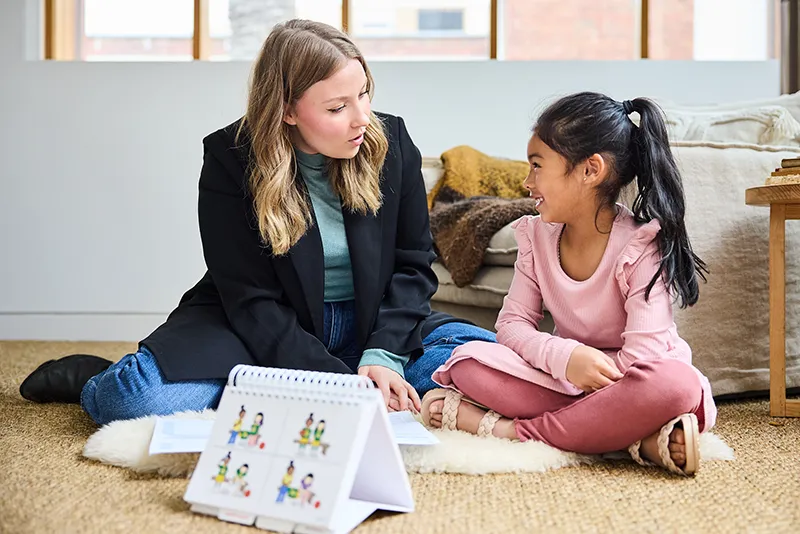
Starting speech pathology for the first time can come with lots of questions.
What will we do?
What will the Speech Pathologist ask?
Does my child need to perform or complete a test?
The good news is that your first speech pathology session is mostly about getting to know you and your child.
Every first session looks a little different depending on your child’s age, communication needs and the reason for the referral. Your Speech Pathologist will spend time learning about your child’s strengths, interests, communication and everyday life. We want to understand not only what your child may find difficult, but also what is important to them and your family.
The session may include talking through your child’s history, informal assessment, observation through conversation or play, and, when relevant, an assessment of eating, drinking and swallowing.
Getting to Know Your Child and Family
We will usually start by having a chat about your child and their case history.
Your Speech Pathologist may ask about your child’s communication development, medical and developmental history, hearing, education, previous supports and any current concerns. We will also want to hear about their strengths, interests, routines and the things that are important to your family.
Parents and caregivers know their child best, so the information you share is an important part of our assessment.
And don’t worry if you can’t remember every milestone, appointment or detail on the spot! We can always come back to things later.
Informal Assessment
Assessment does not always mean sitting at a table and completing a formal test.
Your Speech Pathologist may use play, conversation, pictures, books, games or everyday activities to learn more about your child’s communication skills. Depending on the reason for the referral, we may explore areas such as understanding language, expressing wants and ideas, speech sounds, social communication, literacy, fluency or alternative ways of communicating.
For many children, keeping this part of the session relaxed helps us get a much better picture of how they naturally communicate.
Learning Through Observation
Sometimes, some of the most useful information comes simply from watching, listening and interacting.
Your Speech Pathologist may observe how your child communicates with you, responds to questions or instructions, plays, makes choices, asks for help, starts interactions or lets others know when they have had enough.
Your child may be chatty and engaged straight away, or they may need some time to feel comfortable with a new person. Both are completely okay. Building trust and rapport is an important part of speech pathology, and we do not expect to learn everything about your child in one appointment.
Eating, Drinking and Swallowing, Where Relevant
If your child has been referred because of concerns around eating, drinking or swallowing, the first session may also include a mealtime or swallowing assessment.
Your Speech Pathologist may ask about the foods and drinks your child currently has, their mealtime routines, any coughing or choking, food textures, chewing skills and other concerns you have noticed.
Where appropriate, we may observe your child eating and drinking familiar foods to better understand their skills and determine whether any further assessment or support is needed.
At the end of the first session, your Speech Pathologist will talk with you about what they have observed, answer any questions and discuss possible next steps. This might include further assessment, therapy goals, strategies to try at home, working with other people in your child’s support team, or simply taking some more time to get to know your child.
The first session is a starting point, not a test. Our goal is to understand your child, celebrate their strengths and work together to identify the support that will be most useful for them.
Ready to chat about our Speech Pathology services? Get in touch with the team.